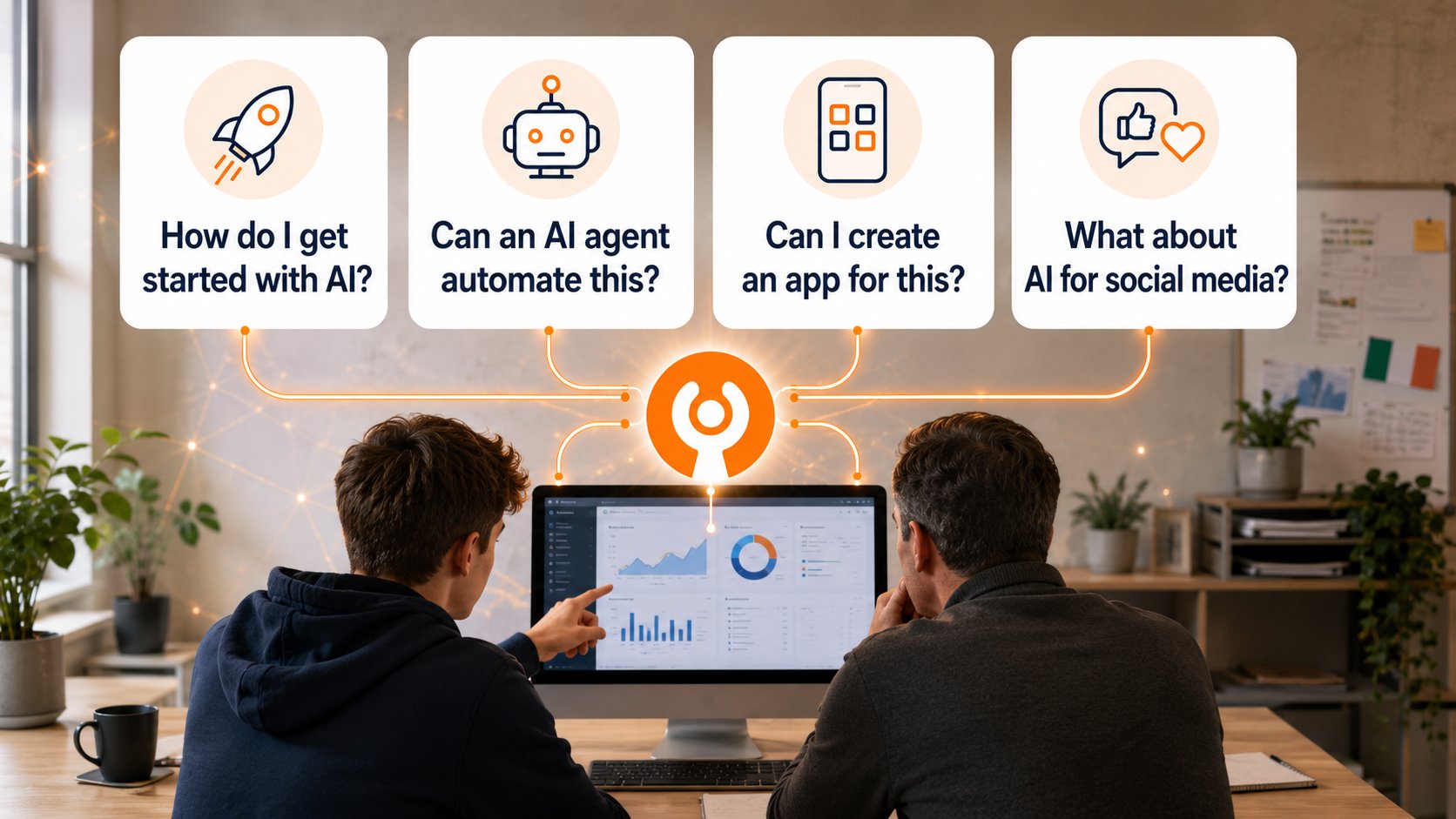
For many small business owners in Ireland, the biggest challenge with AI is not the technology itself. It is knowing where to start.
There is a lot of noise around artificial intelligence. Every week there seems to be a new tool, platform, agent, automation system or productivity claim. For a busy SME owner, that can make AI feel like another complicated technology project that needs consultants, developers, large budgets and months of planning.
The reality is different.
AI is probably one of the most user-friendly new technologies that business owners have ever had to deal with. You do not need a technical background to start using it well. You do not need to rebuild your business around it. You do not need to begin with complex AI agents or expensive custom software.
The key is to keep it simple.
For most small businesses, the real opportunity is to identify the low-hanging fruit: the everyday tasks, processes and bottlenecks where AI can save time, improve consistency or help people make better decisions.
AI is not just a technology challenge
Many SMEs assume that adopting AI is primarily a technical challenge. That is understandable, but it is often the wrong starting point.
The first question should not be:
“What AI tool should we use?”
The better question is:
“Where in the business are we wasting time, repeating manual work, losing enquiries, delaying decisions or relying too heavily on one person’s knowledge?”
That is where AI usually creates value first.
For a small business, useful AI opportunities might include:
- responding more quickly to common customer enquiries;
- summarising emails, documents or meeting notes;
- creating first drafts of marketing content;
- improving follow-up with leads and prospects;
- organising internal knowledge and FAQs;
- automating simple admin tasks;
- analysing customer feedback;
- preparing reports, proposals or job descriptions;
- building simple workflows between existing tools.
None of these require a business to become a technology company. They require a practical understanding of how the business already works and where small improvements would make a difference.
Start with simple business problems
The most successful AI projects usually begin with a clear and narrow business problem.
For example:
- “We spend too much time answering the same questions from customers.”
- “We are slow to follow up with sales leads.”
- “Our team wastes time rewriting the same documents.”
- “We have useful information, but it is scattered across emails, spreadsheets and folders.”
- “We want to improve our marketing output, but we do not have enough time.”
- “We want to test whether an AI assistant could help with internal admin.”
These are good starting points because they are specific, practical and measurable.
A small business does not need to start with a full AI transformation plan. In fact, that can be a mistake. A better approach is to identify one or two areas where AI can make work easier, test the solution, and then build from there.
AI tools are now affordable for SMEs
Another common concern is cost.
Many business owners assume that AI implementation will be expensive. In some cases, it can be, especially where a company needs complex systems, deep integration or custom development. But most SMEs do not need to start there.
Many of the best AI tools for small businesses are now affordable, subscription-based and easy to use. Tools for writing, research, automation, customer support, scheduling, data analysis and internal knowledge management are far more accessible than previous waves of business software.
The real cost is often not the software itself. It is the time needed to understand what to use, how to set it up, and how to apply it properly inside the business.
That is where many SMEs need help.
The real value is in setup, structure and use case selection
AI is powerful, but it still needs direction.
A poorly defined AI project can quickly become a distraction. A well-defined AI project can deliver a practical improvement in a short period of time.
The most important early steps are:
- Identify the right use case
Focus on a real business problem, not a fashionable tool.
- Keep the scope small
Start with a task, workflow or process that can be improved quickly.
- Choose affordable tools
Use existing AI platforms and automation tools where possible.
- Set up the process properly
Make sure the AI output is useful, reliable and easy for the team to adopt.
- Review and improve
Once the basics are working, the business can decide whether to expand the solution.
This approach reduces risk and avoids unnecessary cost.
Once the basics are in place, AI can evolve
A simple first AI project can become the foundation for more advanced use later.
For example, a business might start by using AI to draft customer replies or summarise documents. Over time, that could evolve into a searchable internal knowledge base, a customer support assistant, a lead follow-up workflow or an AI agent that carries out defined tasks under human supervision.
The important point is that the business does not need to jump straight to advanced AI agents.
AI adoption should be staged:
First: identify simple opportunities.
Then: set up useful tools and workflows.
Then: train the team to use them properly.
Then: build towards more advanced automation where there is a clear return.
That is a much more realistic path for most small businesses in Ireland.
How Bowsy helps Irish SMEs get started with AI
Bowsy AI Project Teams help small businesses turn AI from an idea into a working business improvement.
Our model is designed for SMEs that want practical AI support without taking on the cost of a large consultancy or hiring full-time technical staff.
Bowsy combines experienced business scoping with qualified postgraduate student talent in areas such as AI, software, automation, data, marketing and business process improvement. The students work as part of a supervised project team, helping businesses identify opportunities, set up tools and implement useful AI solutions.
This keeps the process affordable while still giving the business structure, oversight and quality control.
Typical projects may include:
- AI opportunity reviews;
- admin automation;
- customer enquiry workflows;
- marketing content systems;
- internal AI assistants;
- simple AI-powered tools;
- workflow improvements;
- AI research and reporting support;
- app or prototype development.
The goal is not to make AI complicated. The goal is to make it useful.
AI should make business easier, not harder
For small businesses in Ireland, the opportunity with AI is significant, but it should be approached practically.
You do not need to start with a major digital transformation project. You do not need a technical background. You do not need to spend heavily before you know where the value is.
The best starting point is simple:
Look at your business. Identify where time is being wasted. Find the repetitive tasks. Look for the bottlenecks. Then test whether AI can help.
In most cases, the challenge is not whether AI can do something useful. The challenge is choosing the right place to begin.
Bowsy helps Irish SMEs make that first step practical, affordable and commercially useful by leveraging postgraduate Irish university students on your doorstep. To find out more, get in touch or visit Bowsy.ie.